
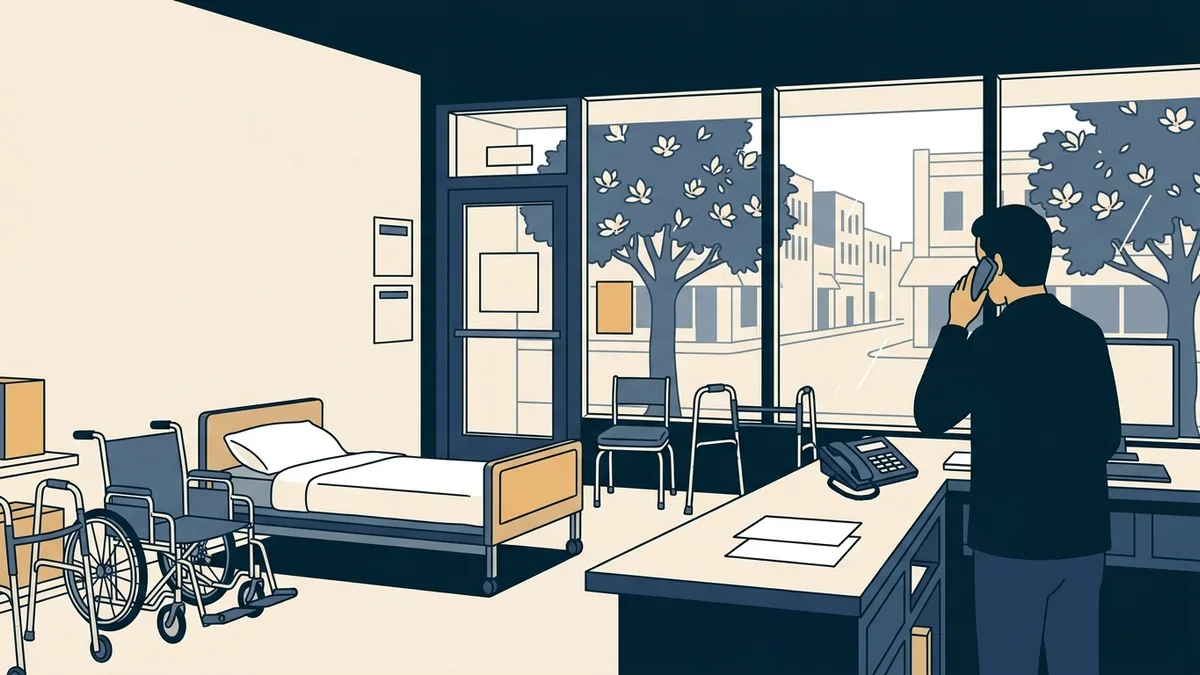
Alabama requires a Board of Home Medical Equipment license for each location providing home medical equipment services, and since June 1, 2014 an out-of-state provider must keep at least one licensed physical location in Alabama. Carrier-only mail order is exempt, except for respiratory and oxygen equipment. Licenses expire August 31; renewal is $250.
Alabama requires a license from the Alabama Board of Home Medical Equipment for every home medical equipment services provider, location by location, and it is the hardest state we have read for a supplier based elsewhere. Since June 1, 2014, a provider whose principal place of business is outside Alabama must "maintain at least one physical location within the state, each of which must be licensed by the Board of Home Medical Equipment" (Ala. Admin. Code 473-X-3-.02, implementing Act 2014-172). Renewal is $250 a year, and every license expires August 31 (473-X-8-.01).
What does Alabama count as home medical equipment?
Nearly everything a DME supplier sells. The Board's definition includes "wheelchairs and power-operated vehicles ('scooters'), wheelchair cushions and seating systems, hospital beds, traction equipment, canes, crutches, walkers; respiratory care equipment, including positive air pressure devices, invasive and non-invasive ventilators, apnea monitors, aerosol compressors, nebulizers, oxygen therapy equipment"; any product the FDA defines as a medical device intended for home use; any prescription-legend device; and "any product eligible to be reimbursed under the Healthcare Common Procedure Coding System (HCPCS) code listing by any insurance provider," including Medicare Part B and Alabama Medicaid DME (473-X-1-.01(4)).
How does the in-state location rule work?
Before 2014, out-of-state providers only had to show a qualifying physical location somewhere and accept inspection. Act 2014-172 changed that. Now an out-of-state provider must have at least one licensed Alabama location (473-X-3-.02). Once it does, it "may provide home medical equipment and services to its Alabama customers through any corporate branch or location, including an out of state location," and the ownership of the licensed Alabama location "will be responsible to the Board for any equipment or services provided to the customer by any other corporate branch or location."
Two limits apply. A "corporate branch or location does not include a corporate subsidiary or affiliate that would itself require a license," and the out-of-state branch must be licensed under the law of its own state. The Board's Application for Out of State Designation is how a licensed Alabama provider adds such a branch, and its renewal application includes an acknowledgment that the Alabama location answers for those branches (473-X-8-.01(4)(b)).
The location has to be real. The Board's inspection standards require "a physical facility on an appropriate site" with space for business, delivery, maintenance and patient records, and say "a residence, post office box or commercial mailbox is not considered a physical facility." The facility must be staffed during normal business hours, have a visible sign with the business name, hours and phone number, and use a listed business phone or toll-free number; "The exclusive use of a beeper, answering machine, answering service, or cell phone during posted business hours is prohibited" (473-X-4-.01(2)-(4)).
Is there an exception for mail-order suppliers?
A narrow one. Alabama's statute, as posted by the Board, exempts "Mail order companies, if deliveries are made only via common carriers, including the United States Postal Service" (Code of Ala. 34-14C-5(9)). The Board's rule then defines a mail order company tightly (473-X-1-.01(8)):
- it takes orders by phone, mail or internet and "delivers such products directly to the consumer via a postal service, such as the U.S. Postal Service (USPS), UPS, FedEx or another courier service";
- a company that supplies "respiratory care and oxygen equipment" to Alabama consumers this way, "or any other home medical equipment necessary to avert an immediate threat to a consumer's health or safety," is not a mail order company;
- a provider whose "employees, agents or subcontractors enter the consumer's residence to service home medical equipment ... or to instruct consumers" is not a mail order company either;
- mail order companies must comply with the FTC's mail order rule (16 CFR 435.1 to 435.3) and USPS rules.
So a supplier shipping off-the-shelf braces or urological supplies by carrier, with no one entering the home, may fit the exemption. A supplier shipping CPAP machines, nebulizers, ventilators or oxygen equipment does not, because those are respiratory care equipment under the Board's definition. Medicare's rule still applies on top: a supplier must hold whatever license a state requires for the items it furnishes. See mail-order DME and the states you ship to.
Who else is exempt?
The statute's exemption list, as posted by the Board, also includes home health agencies certified by Alabama to participate in Medicare and Medicaid; hospital-based home medical equipment services; practitioners who order or use equipment to treat patients outside the patient's residence (but not those who provide services in the residence); manufacturers and wholesale distributors not selling directly to the patient; "Retail community pharmacies, including providers of home infusion therapy services"; hospices and skilled nursing facilities, except those delivering equipment to a patient's residence; and governmental agencies (Code of Ala. 34-14C-5). A pharmacy-owned DME company run as a separate business should read the pharmacy exemption closely before relying on it, and Medicare's own pharmacy rules are separate again. See DMEPOS enrollment for pharmacies.
What does the Board inspect and ask for?
The Board inspects applicants before licensing and may inspect randomly, on complaint or at renewal; an applicant that fails the first inspection pays a re-inspection fee of up to $300 (473-X-4-.01(1), (7)-(8)). The application, under 473-X-3-.01(7), asks for:
- the business name, physical location, mailing address and trade names, and the person in charge of each other branch serving Alabama customers;
- the manager or person in charge of day-to-day operations;
- hours and days of operation and the equipment and services provided;
- certification of comprehensive liability insurance "in the amount of at least $300,000" covering the place of business, consumers and employees, plus product liability if the provider manufactures its own items;
- a full ownership disclosure, down to shareholders, members and parent companies;
- proof of citizenship or legal presence;
- a certification "signed by a person with the authority to bind the applicant and notarized under oath."
The Board's own instructions add that it "will not act as your agent in gathering information or supporting documents," that incomplete applications are returned, and that each physical location needs its own license. Changes in the application information must be reported within 30 days; a change of address requires a new site inspection and a change of person in charge requires its own form (473-X-3-.01). The application instructions also quote the Act's penalty for unlicensed service: an administrative fine of $1,000 for each day services were provided without a license.
Does accreditation substitute for the license?
No. The Board's application instructions state that "Accreditation by the Joint Commission on Accreditation of Healthcare Organizations, the Community Health Accreditation Program, or other accrediting entities shall not be substituted for the compliance with this act." Your Medicare accreditation helps you meet the standards; it does not replace the Alabama license or inspection.
When does an Alabama license expire?
"The Home Medical Equipment license shall be valid for one (1) year, expiring on August 31st of each year," with the first period prorated to that date but not the fee. A license may still be renewed in the 60 days after August 31 with the $250 renewal fee and a $150 late fee. After 60 days the license lapses, the Board sends a cease and desist letter, "a new application and inspection will be required," and from November 1 the Board may notify Medicare, Medicaid and other payers of lapsed licenses. Renewals are submitted online through the Board's website, or manually on written request (473-X-8-.01). See a renewal calendar for state DME licenses.
Why does this matter for competitive bidding?
CBIC's Round 2028 FAQs acknowledge that some small suppliers cannot meet "the requirement for a physical location in a specific state," and answer that a network of small suppliers can meet the licensing requirements collectively. For a single national supplier, Alabama usually means a real Alabama location. Plan it early: the lease, the staff, the sign and the inspection all come before the license, and the license must be current in PECOS by the close of the bid window. See the bid window licensing deadline.
How do we help with Alabama?
Alabama is one of our complex states at $899 (pricing). We check whether the mail-order exemption fits your products, prepare the location's application, ownership disclosure, insurance certification and inspection file, and the out-of-state designation for your other branches, and track the August 31 renewal. Your authorized signer signs the notarized certification, you pay the Board directly, and the Board's online renewal account stays yours. See the Alabama state page.
Common questions
- Do out-of-state DME suppliers need an Alabama location?
- Yes, unless exempt. Since June 1, 2014, a provider based outside Alabama must maintain at least one licensed physical location in Alabama, and may then serve Alabama customers through designated out-of-state branches (Ala. Admin. Code 473-X-3-.02).
- Are mail-order suppliers exempt in Alabama?
- Only if they deliver solely by carrier, never enter the home, and do not supply respiratory care or oxygen equipment or equipment needed to avert an immediate threat to health (Code of Ala. 34-14C-5; Ala. Admin. Code 473-X-1-.01(8)).
- When do Alabama HME licenses expire?
- Every August 31. Renewal is $250; in the 60 days after August 31 it is $250 plus a $150 late fee. After that the license lapses and a new application and inspection are required (473-X-8-.01).
- Does accreditation replace Alabama's license?
- No. The Board's application instructions say accreditation by The Joint Commission, CHAP or other accrediting entities shall not be substituted for compliance with the Act.
Need Help with Enrollment or Licensing?
We prepare your Medicare enrollment, accreditation survey and state licenses in the order CMS requires, for your official to sign, and track every one to a decision.