
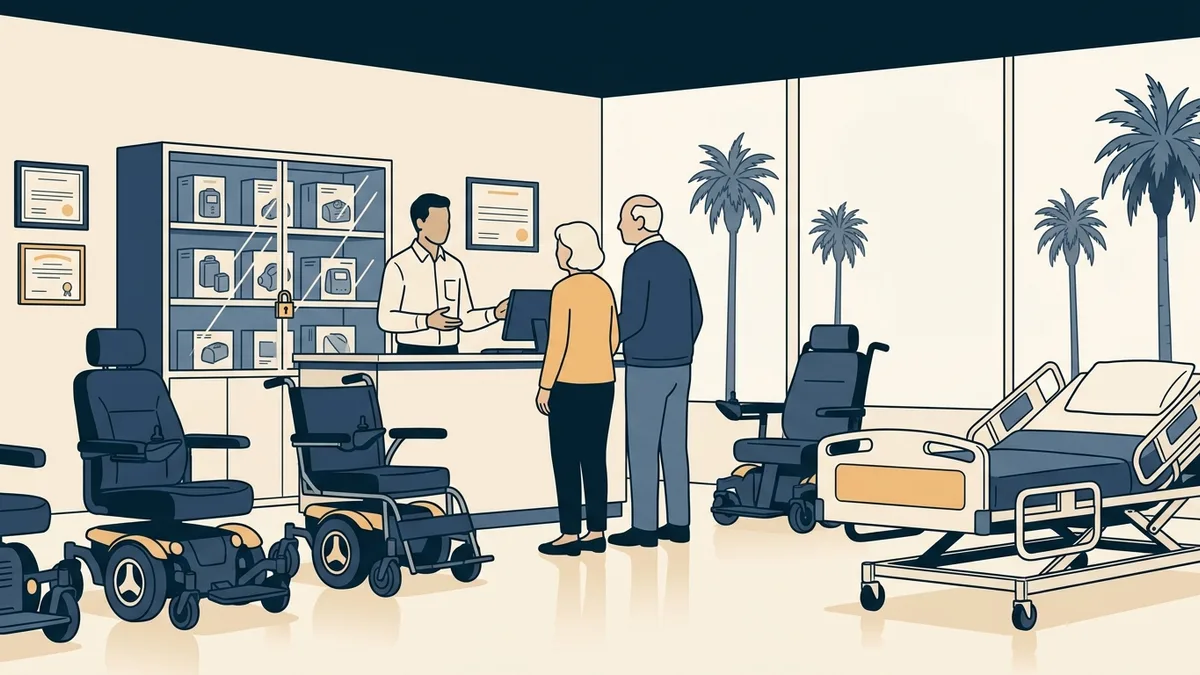
California requires a home medical device retailer license from CDPH for each in-state facility, renewed yearly at $1,584 as of July 23, 2026. Out-of-state suppliers of prescription devices register instead for $280 a year. A pharmacist or CDPH-licensed exemptee must be in charge where prescription devices are sold, and CDPH inspects before licensing.
California requires a home medical device retailer (HMDR) license from the California Department of Public Health (CDPH), Food and Drug Branch, for every facility in the state that sells or rents home medical devices to patients. "No person shall conduct a home medical device retail facility business in the State of California unless he or she has obtained a license from the department" (Health & Safety Code 111656(a)). Out-of-state suppliers of prescription devices register with the same program instead of licensing. As of the fee notice effective July 23, 2026, the in-state license is $1,584 a year and the out-of-state registration is $280 a year.
Two features make California different from most states. The license comes from the health department, not the pharmacy board. And any facility selling prescription devices needs a pharmacist or a CDPH-licensed exemptee in charge.
Who needs an HMDR license?
Any business operating a home medical device retail facility in California. A separate license is required "for each of the premises" of a business with more than one location, the license "shall be renewed annually," and it "shall not be transferable" (111656(a)). CDPH describes in-state facilities as those that "supply prescription medical devices or durable medical equipment for use in the home to treat acute or chronic illnesses or injuries."
The statute exempts several kinds of businesses unless they furnish home medical devices through a separate entity, division or company (111656(f)). The ones suppliers most often ask about:
- home health agencies that do not have a Medicare Part B supplier number;
- hospitals, but not home medical device providers owned by or related to a hospital;
- manufacturers and wholesale distributors, "if not selling directly to the patient";
- practitioners who prescribe or use home medical devices to treat their patients;
- licensed pharmacies, which "shall be governed by" the pharmacy law and the Board of Pharmacy's rules instead;
- licensed hospices and nursing homes.
A pharmacy that sells or rents equipment is therefore regulated by the Board of Pharmacy, not CDPH, for that business. A medical supply company spun out of a hospital or a pharmacy as a separate entity is not covered by those exemptions.
What does the out-of-state registration cover?
An out-of-state retailer "shall not sell or distribute prescription devices in this state" through anyone other than a licensed California wholesaler without registering as an out-of-state home medical device retail facility (111656.7(a)). Registration "shall be renewed annually" (111656.8(d)). CDPH states that out-of-state facilities "must supply prescription medical devices in order to qualify for the registration."
That last point matters for mail-order suppliers. A supplier shipping prescription devices into California registers; the registration is built around prescription devices, so a supplier that ships none should confirm with CDPH how its products are treated rather than assume. The out-of-state form (CDPH 8679O, July 2026) asks you to check the products you will sell and marks respiratory equipment, oxygen supplies, CPAP and BiPAP units, infusion pumps and catheters as prescription devices that require a pharmacist-in-charge or licensed exemptee "on premises." See mail-order DME and the states you ship to.
How much are the CDPH fees?
CDPH sets the fees under 111656.1 and raised them 5 percent effective July 23, 2026. The current amounts:
| License type | Fee | Frequency |
|---|---|---|
| HMDR, new and renewal | $1,584 | Annual |
| HMDR out of state, new and renewal | $280 | Annual |
| HMDR warehouse, new and renewal | $791 | Annual |
| HMDR exemptee, new application | $466 | One time |
| HMDR exemptee, renewal | $280 | Annual |
A warehouse used for storage and not for dispensing is licensed at half the facility fee, and there is no separate fee for warehouse space physically connected to the retail premises (111656(c)). The out-of-state form adds a $10 late fee when a renewal arrives more than 30 days after the expiration date. One date to watch: the fee section itself, 111656.1, "shall remain in effect only until January 1, 2028, and as of that date is repealed" (111656.1(g)) unless the legislature acts.
Must a pharmacist or an exemptee be in charge?
California law generally restricts prescription devices to pharmacies. Section 111656.4 lets a home medical device retailer sell or dispense them if "sufficient qualified supervision" is in place: "A licensed pharmacist or an exemptee ... shall be in charge of the home medical device retail facility." The exemptee must:
- be a high school graduate or hold a GED;
- have at least one year of paid work experience "related to the distribution or dispensing of dangerous drugs or dangerous devices";
- complete training covering state and federal law on drugs and devices, quality control, USP storage and handling standards, safe handling of home medical devices, and prescription terminology.
The pharmacist or exemptee "shall be on the premises at all times that prescription devices are available for sale or fitting," unless the devices are stored separately under that person's exclusive control (111656.4(b)). A warehouse needs someone designated in charge, who need not be present (111656.5(b)). The exemptee license is separate: $466 to apply and $280 a year. Staffing rules across states are compared in designated representatives and exemptees.
Will CDPH inspect the facility?
Yes, before the license issues: "prior to issuing a license ... the department shall inspect each place of business to determine ownership, adequacy of facilities, and personnel qualifications" (111656.1(a)(1)). After that, the schedule depends on accreditation. A licensee accredited by a CMS-approved accrediting organization, meeting the conditions in the statute, is inspected "only upon a complaint." A licensee without that accreditation is inspected "at least annually" (111656.1(a)(2)-(3)).
The inspector will look for the standards the article sets: prescription devices stored with no customer self-service (111656.2), written policies on staff and patient training, cleaning and maintenance, records, security and quality assurance, and emergency service "24 hours per day, 365 days per year" where a device malfunction could threaten a patient's health (111656.3). Training and competence records are kept for three years after an employee leaves (111656.3(d)).
One accreditation note: the Board of Certification/Accreditation (BOC) said in January 2026 that its restrictions on new accreditation and reaccreditation of suppliers in California, Florida, New York and Texas remain in place. A California supplier choosing an accrediting organization should factor that in.
Who signs the application?
The owner. Both CDPH forms say "Owner of the facility must sign here," and the out-of-state form's certification is made "Under penalty of perjury" by a person who is "the applicant, or one of the owners or managers of the applicant corporation ... duly authorized to make this application on its behalf." The in-state form also lets the owner give "permission for the below authorized representatives and/or signatories to speak about the application with CDPH," and the out-of-state form has a correspondent field. That is where a preparer fits: we can be named to answer CDPH's questions, while the owner signs and pays.
Each form wants a separate application for each place of business, a copy of the business license and seller's permit, evidence of ownership, owners' and officers' names, the product list, and proof of Medi-Cal or Medicare status and accreditation if you have them. CDPH says "Incomplete Applications Will be Returned."
How does this fit with Medicare enrollment?
California's license is one of the "required licenses" a California location lists on the CMS-855S in Section 2D, and an accrediting organization verifies licensure when you apply for accreditation (CMS fact sheet MLN905710). In practice the HMDR license, the exemptee and the facility come first, then accreditation, then enrollment. See DMEPOS enrollment, step by step and the California state page.
Can we prepare your California license?
California is one of our complex states at $899 (pricing). We prepare the CDPH application and attachments, the exemptee application if you need one, the policies the inspector will ask for, and the product list, and we track the annual renewal. Your owner signs, and you pay CDPH's fees directly. We can mail the signed application for you. CDPH decides, and we cannot promise an approval or a date.
Common questions
- Does the California Board of Pharmacy issue the DME license?
- No. The home medical device retailer license comes from the California Department of Public Health, Food and Drug Branch. Pharmacies that sell or rent devices are exempt from it and stay under the Board of Pharmacy (Health & Safety Code 111656(f)(5)).
- Do out-of-state DME suppliers need a California license?
- An out-of-state supplier of prescription devices registers with CDPH as an out-of-state home medical device retailer, renewed annually, at $280 a year as of July 23, 2026. CDPH says out-of-state facilities must supply prescription devices to qualify.
- What is an HMDR exemptee?
- A CDPH-licensed person who can be in charge of a facility selling prescription devices in place of a pharmacist. The exemptee needs a high school diploma or GED, a year of related paid experience and approved training. The license is $466, then $280 a year.
- Does accreditation reduce California inspections?
- After the initial inspection, a licensee accredited by a CMS-approved organization is inspected only on a complaint, if the statute's conditions are met. A licensee without that accreditation is inspected at least once a year.
Need Help with Enrollment or Licensing?
We prepare your Medicare enrollment, accreditation survey and state licenses in the order CMS requires, for your official to sign, and track every one to a decision.