
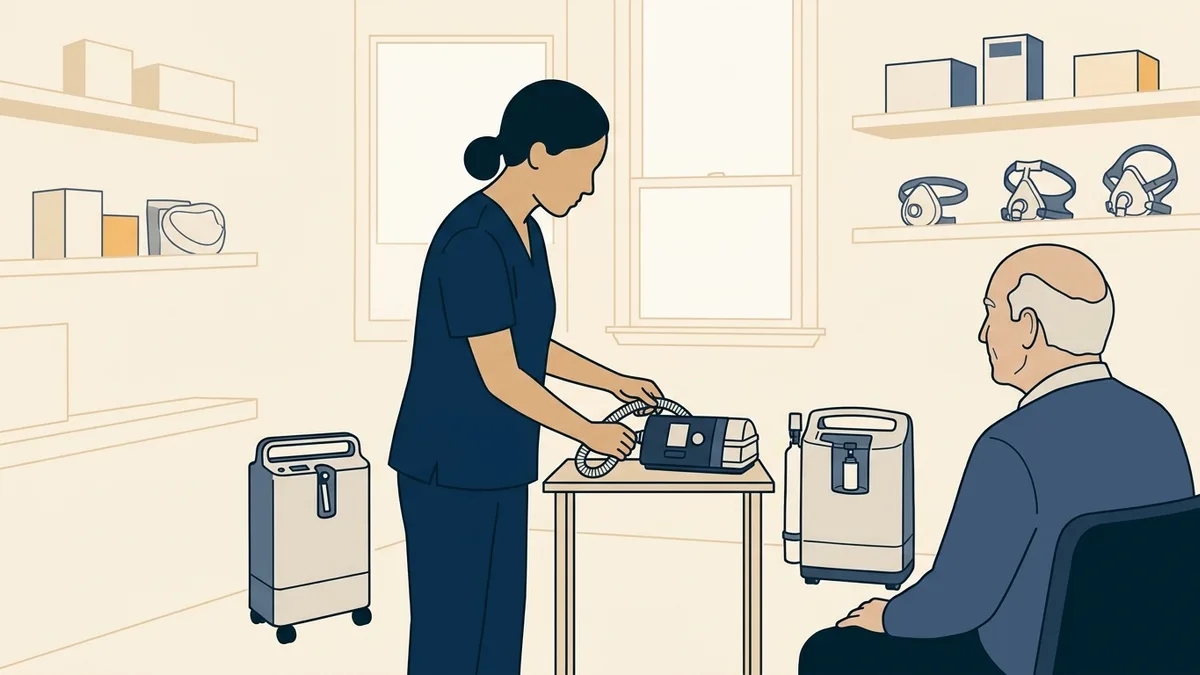
Commercial, Medicare Advantage and Medicaid managed care plans contract DME suppliers separately from Medicare, often through a DMEPOS network manager. Plans typically expect a Medicare PTAN, accreditation covering the products, state licenses, insurance and records that match PECOS. Medicaid managed care also requires state Medicaid enrollment. Finish Medicare and licensing first.
A Medicare PTAN lets a DME supplier bill Original Medicare. It does nothing for a patient whose coverage comes from an employer plan, a marketplace plan, a Medicare Advantage plan or a Medicaid managed care plan. Each of those plans has its own network, its own application and its own decision about whether it needs another supplier. For many suppliers that is where most of the revenue is, and it is a separate project from Medicare.
Why isn't Medicare enrollment enough?
Because the plan, not CMS, is the payer. A commercial plan contracts with the suppliers it chooses. A Medicare Advantage plan pays its own network. A Medicaid managed care plan contracts with suppliers too, though federal rules require the state to screen and enroll every one of those network providers (42 CFR 438.602(b)). The Medicare enrollment still matters, because plans use it as proof that the supplier exists, meets the supplier standards and is accredited, but it is the starting point, not the contract.
What do plans usually ask a DME supplier for?
Requirements differ by plan, so treat this as a checklist to confirm, not a rule. Expect to provide most of these:
- Medicare enrollment: the PTAN for each location you want in the network.
- Accreditation from a CMS-approved accrediting organization, covering the product lines you will bill the plan for. Medicare itself requires accreditation that names the specific products and services (42 CFR 424.57(c)(22)), and plans tend to follow it.
- State licenses for the state you are in and, for a plan covering members elsewhere, the states where you would deliver.
- Medicaid enrollment if the plan is a Medicaid managed care plan; see Medicaid DME enrollment.
- Liability insurance certificates. Medicare's minimum is $300,000 (424.57(c)(10)); some states set higher amounts for their licensees.
- Ownership, NPI, tax ID and W-9, matching your NPPES and PECOS records exactly.
- A product and service list, service area, hours, delivery and after-hours coverage.
- Exclusion screening of the company, owners and managing employees.
Who decides if you get in?
Often not the plan itself. Many health plans hand DMEPOS to a specialty network manager that recruits and contracts suppliers, handles prior authorization and pays claims. Blue Cross Blue Shield of Michigan is a documented example: its April 2026 FAQ says Northwood, Inc. "administers and manages all aspects" of DMEPOS for several of its Michigan products, including "managing the supplier network (provider contracting and provider management), prior authorizations, provider appeals and member services, and paying claims." For those members, a supplier applies to Northwood, not to the Blue plan. See DMEPOS network managers.
Before you apply, find out which entity actually contracts DME for the plan. Applying to the wrong one is the most common wasted month.
What if a plan says it does not need more suppliers?
A plan may decline because it has enough suppliers for a product line or area. Your best response is information the plan can use: a product line or service it lacks, a geographic gap you fill, after-hours or specialty support, or members already asking for you. Ask what would change the answer and when it reviews again. Our sister company, White Glove Credentialing, handles plan applications and follow-up; their guide on how to get on insurance panels explains how plans make the call.
Which Medicare details cause commercial applications to stall?
- Records that do not match. A plan will compare your application against PECOS and NPPES. A different legal name format or a stale address triggers questions.
- Accreditation that does not cover the product. If your accreditation lists respiratory equipment but not orthotics, a plan may not contract you for braces.
- Unreported changes. Medicare requires changes to be reported within 30 days (424.57(c)(2)); a plan that finds a mismatch will wait for you to fix it. See the 30-day rule.
- Licenses missing for the member's state. A plan covering patients in several states will expect licenses where your deliveries go. See mail-order DME and the states you ship to.
- Approaching revalidation or reaccreditation. Accreditation is now renewed at least every 12 months (424.57(c)(24)); a lapse shows up everywhere at once.
How does Medicare Advantage differ from Original Medicare?
A Medicare Advantage patient's DME is paid by the plan under the plan's network and authorization rules, not by the DME MAC. Some plans route certain products elsewhere entirely. The BCBSM FAQ, for example, says that for its Medicare Advantage members, CGM products must come from a participating network pharmacy for dates of service on or after October 1, 2024, with stated exceptions. A supplier that assumes Medicare rules apply to a Medicare Advantage patient can deliver an item the plan will not pay for. For the billing side, see White Glove Medical Billing on why Medicare Advantage is not Medicare.
In what order should a supplier work?
- Finish Medicare: accreditation, enrollment, PTAN for each location.
- License every state you deliver to that requires it.
- Enroll in Medicaid in the states where you want Medicaid or Medicaid managed care patients.
- Identify which plans, and which network managers, cover the patients your referral sources send you.
- Apply, then keep every record in sync as you grow.
Where does our work end and the plan work begin?
We handle steps 1 to 3: the Medicare DMEPOS Enrollment Package ($1,295 for the first location), state licenses ($699 per state, $899 in California, Florida, Georgia and Alabama), Medicaid DME Enrollment ($499 per state) and Change of Information ($249) to keep PECOS clean. Commercial, Medicare Advantage and Medicaid managed care plan applications belong to White Glove Credentialing, a sister company, and we hand those off with your Medicare file ready. No one can promise a plan will contract you. Start with a $149 Readiness Review to see what a plan will find when it checks your records.
Common questions
- Does a Medicare PTAN get my DME company into commercial plans?
- No. Each commercial or Medicare Advantage plan contracts suppliers itself or through a network manager. Plans usually ask for the PTAN and accreditation as proof, but the contract is a separate application.
- Who do I apply to if a plan uses a DMEPOS network manager?
- The manager. For example, BCBSM's April 2026 FAQ says Northwood manages the DMEPOS supplier network for several Michigan products, and suppliers apply through Northwood's provider application site.
- Can I join a Medicaid managed care plan without state Medicaid enrollment?
- Only temporarily. Under 42 CFR 438.602(b), the state must enroll every network provider; a plan can contract pending enrollment for up to 120 days, then must terminate if enrollment does not happen.
- Does White Glove DME submit plan applications?
- No. We handle Medicare enrollment, accreditation readiness, state licenses and Medicaid enrollment. Commercial and managed care plan applications are handled by our sister company, White Glove Credentialing.
Need Help with Enrollment or Licensing?
We prepare your Medicare enrollment, accreditation survey and state licenses in the order CMS requires, for your official to sign, and track every one to a decision.