
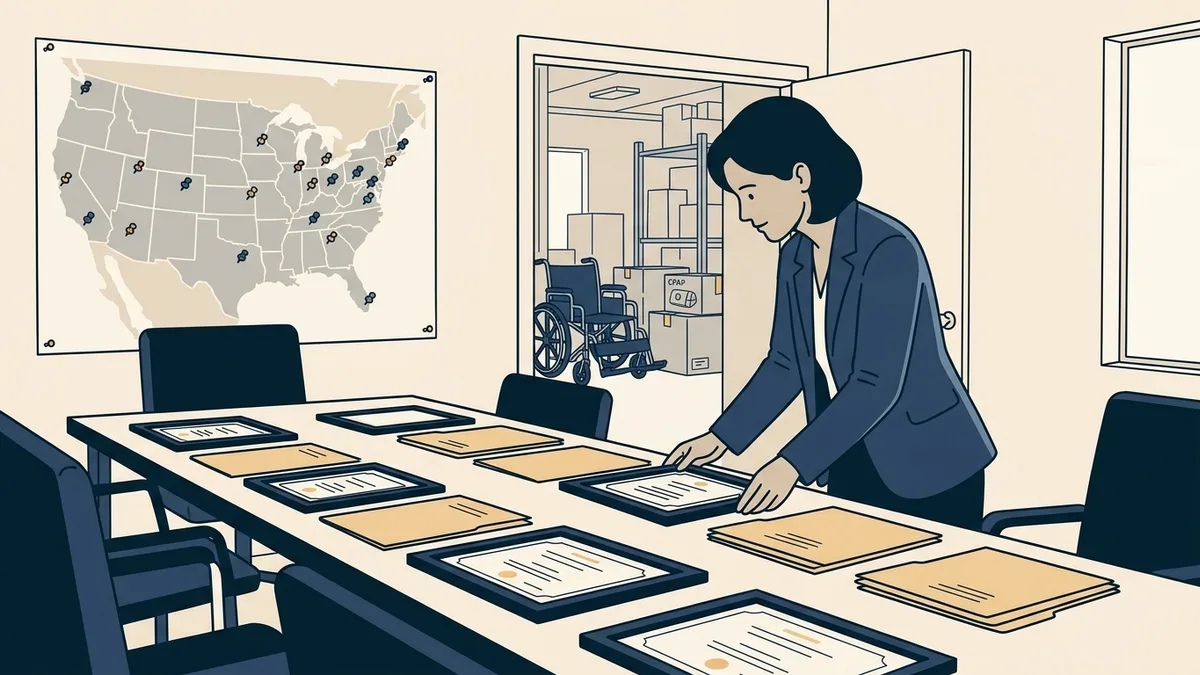
There is no national DME license. Each state decides whether a supplier needs a license, permit or registration, usually per location. Florida, California, Ohio, Tennessee and others license suppliers directly; North Carolina, Virginia and Mississippi use pharmacy board permits; Texas has no general supplier license. Medicare requires whatever license each state you serve requires.
A supplier that delivers durable medical equipment to patients needs whatever license each state requires, state by state and usually location by location. There is no national DME license, and no single list anywhere settles the question. Medicare makes the point in its own rules: a supplier must operate in compliance with "State licensure and regulatory requirements," and "If a State requires licensure to furnish certain items or services, a DMEPOS supplier" must be licensed to provide them (42 CFR 424.57(c)(1)(ii)).
The CMS-855S puts that rule into practice. In Section 2D the supplier selects every state where it provides items to Medicare patients from each business location and, "For each State/Territory selected, submit all required licenses for the products and services being provided." The form points to the enrollment contractors' websites for guidance, and the competitive bidding contractor calls the contractors' DMEPOS Licensure Database Directory "a guide only." The statute or rule is what counts, so that is what we read.
How do states regulate DME suppliers?
The states we have read so far fall into a few patterns. None of them fits every product, so a supplier can sit in two at once.
- A dedicated home medical equipment license. Florida (Agency for Health Care Administration), California (Department of Public Health), Illinois (Department of Financial and Professional Regulation), Ohio (Board of Pharmacy), Alabama (Board of Home Medical Equipment), Tennessee (Health Facilities Commission), Kentucky (Board of Durable Medical Equipment Suppliers) and Indiana (Board of Pharmacy) all license home medical equipment providers under laws written for them.
- A pharmacy board permit for equipment suppliers. North Carolina, Virginia, Mississippi, Louisiana, Georgia and North Dakota license DME suppliers through the Board of Pharmacy, often triggered by prescription devices, oxygen or medical gas.
- A general drug and device registration. Pennsylvania has no dedicated HME license, but its Department of Health rules require everyone who "manufactures, distributes or retails drugs or devices within the Commonwealth" to register every year, per place of business (28 Pa. Code 25.113).
- No general supplier license, but product rules. Texas licenses device distributors, not retailers selling to patients, so a typical supplier needs no general DME license there. Wisconsin licenses home medical oxygen providers but has no general DME license (Wis. Stat. 450.076). Oxygen, drugs and custom orthotics and prosthetics can still need their own licenses in any state.
Which states have we verified so far?
Every row below comes from the statute, rule or agency fee schedule cited, read in October 2026. Fees are the state's, paid by the supplier, and change; check the date before you rely on one.
| State | What the supplier needs | Out-of-state suppliers | State fee (as of October 2026) | Where it is written |
|---|---|---|---|---|
| Alabama | HME license from the Board of Home Medical Equipment, per location | Must keep at least one licensed physical location in Alabama | $250 renewal a year | Ala. Admin. Code 473-X-3-.02, 473-X-8-.01 |
| California | Home medical device retailer license from CDPH | Out-of-state registration for suppliers of prescription devices | $1,584 a year in state; $280 a year out of state | Cal. Health & Safety Code 111656, 111656.7 |
| Florida | HME provider license from AHCA, per location | Out-of-state locations licensed; must be accredited | $304.50 every two years, plus a $400 inspection fee if required | Fla. Stat. 400.93, 400.931; Fla. Admin. Code 59A-25.002 |
| Georgia | DME supplier license from the Board of Pharmacy, per location | Out-of-state permit only for licensed manufacturers or wholesalers | $750 initial; $600 renewal every three years | Ga. Comp. R. & Regs. 480-7B-.02; Board fee schedule |
| Illinois | HME and services provider license from IDFPR, unless exempt | Not addressed in the sections we read | $300 application; renewal at $100 a year | 225 ILCS 51/15; 68 Ill. Adm. Code 1253.70 |
| Indiana | HME services provider license from the Board of Pharmacy | Must maintain a physical facility and inventory in Indiana | $150 initial | IC 25-26-21-6; 856 IAC 1-39-7 |
| Kentucky | HME and services provider license from the Board of Durable Medical Equipment Suppliers | Covered; an inspection outside Kentucky is billed at its full cost | $350 license, $350 renewal | KRS 309.412; 201 KAR 47:010 |
| Louisiana | DME permit from the Board of Pharmacy | Covered; must register with the Secretary of State | $200 application; $200 renewal a year | La. Admin. Code tit. 46, LIII-2403, LIII-115 |
| Mississippi | Medical Equipment Supplier Permit from the Board of Pharmacy | Covered by name, in state or out | $150 application | Miss. Code 73-21-108 |
| North Carolina | Medical equipment permit or device permit from the Board of Pharmacy | Covered by name, in state or out | $500 original; $200 renewal a year | N.C. Gen. Stat. 90-85.22, 90-85.24 |
| North Dakota | Retail DME retailer license from the Board of Pharmacy | Must be licensed and registered with the Secretary of State | $200 | N.D. Cent. Code 43-15.3-11, 43-15.3-12 |
| Ohio | HME license (Ohio locations) or certificate of registration (accredited providers) | Registration only, and accreditation is required | $150 registration; $300 license | Ohio Rev. Code 4752.02; Ohio Admin. Code 4729:11-2-01 |
| Oklahoma | DME supplier license from the Board of Pharmacy, per location | Needs an Oklahoma office or a location within 100 miles of each patient, except for specialized products | Not confirmed | Okla. Admin. Code 535:20-10-3 |
| Pennsylvania | Annual Department of Health registration for anyone who retails drugs or devices, per place of business | Rule addresses out-of-state manufacturers and distributors, not retailers | $25 a year for devices | 28 Pa. Code 25.113, 25.115 |
| Tennessee | HME license from the Health Facilities Commission | No Tennessee location required | $1,404 a year | Tenn. Comp. R. & Regs. 0720-30-.02 |
| Texas | No general DME supplier license | Out-of-state distribution exempt from the distributor license | None for a general license | 25 Tex. Admin. Code 229.433, 229.434 |
| Virginia | Medical equipment supplier permit from the Board of Pharmacy, for listed items | Nonresident registration for listed items | $350 initial and $350 a year (in state) | Va. Code 54.1-3435.2, 54.1-3435.3:1; 18VAC110-20-20 |
| Wisconsin | No general DME license; a home medical oxygen provider license for oxygen | Oxygen license applies to oxygen provided to patients in Wisconsin | Set by the licensing department | Wis. Stat. 450.076 |
State pages with more detail live in our state DME license index, for example Florida, California and Tennessee. States not in the table are being confirmed against their own law, and we mark them that way rather than guess. Rules also change: Montana's Board of Pharmacy adopted new device, durable medical equipment and medical gas supplier licensing rules for non-pharmacy facilities effective December 6, 2025 (Mont. Admin. R. 24.174.2001-2002), so a list written before then is out of date.
Where do out-of-state suppliers get caught?
Most surprises come from the rules for suppliers based somewhere else. Five patterns repeat.
- An in-state location is required. Since June 1, 2014, an Alabama HME provider based outside the state must "maintain at least one physical location within the state, each of which must be licensed" (Ala. Admin. Code 473-X-3-.02). Indiana's statute requires a provider to "Maintain a physical facility and medical equipment inventory in Indiana" (IC 25-26-21-6(b)(2)).
- Only certain out-of-state businesses qualify. Georgia's rule reaches "any Medicare enrolled out-of-state DME manufacture or wholesale distributor," and the Board's November 2024 application says an applicant not licensed as a manufacturer or wholesaler does "NOT QUALIFY under the law for an out-of-state GA DME permit."
- Accreditation is the price of entry. Ohio lets a provider outside Ohio apply only for a certificate of registration, which requires accreditation (Ohio Admin. Code 4729:11-2-01(A)(3)(a), (B)). Florida requires an out-of-state applicant to show accreditation, or proof within 120 days, or the application is withdrawn (Fla. Stat. 400.931(2)).
- A home-state license is a prerequisite. Virginia's nonresident registrant must hold its home state's license if that state requires one, or prove it meets Virginia's standards if not (Va. Code 54.1-3435.3:1(B)). Georgia's application asks for the same proof.
- The license follows the product. California registers out-of-state retailers that sell prescription devices (Health & Safety Code 111656.7). Virginia's nonresident registration covers syringes and needles, medicinal oxygen, prescription-only devices, peritoneal dialysis solutions and sterile water or saline. A supplier of other items may fall outside both.
More on the out-of-state rules in licensing as an out-of-state DME supplier and mail-order DME and the states you ship to.
Why not use one of the free 50-state lists?
Because the ones we checked are wrong in ways that cost money. Several online lists say Texas requires a DME supplier license. The Texas rule defines a licensed distributor as one who moves devices "to the person who makes final delivery or sale to the ultimate user," and exempts "distribution from a place of business located outside the State of Texas" (25 Tex. Admin. Code 229.433(8), 229.434(a)(2)). A list that gets Texas wrong may also miss Indiana's in-state facility rule or Georgia's out-of-state limit. See does Texas require a DME license?
When do licenses have to be in place?
Before accreditation and before the 855S, in practice. CMS's accreditation fact sheet (MLN905710) says the accrediting organization reviews your application and "verifies organizational chart and licensure," and that if a supplier violates a supplier standard, "like not being appropriately licensed," the enrollment contractors may deny enrollment or revoke billing privileges. For Round 2028 competitive bidding, every required license must be "current and non-expired" in PECOS "by the close of the bid window," according to CBIC's Licensure for Bidders page. See getting your state licenses into PECOS and the bid window licensing deadline.
What do we do, and what does the supplier do?
We map the states you serve against their law, prepare each application and every attachment, and track renewals. Your owner or an officer signs each application, and you pay each state directly. We can send a signed paper or emailed application for you; a state's online portal stays in your own account. No one can promise a state's decision or timeline, and we do not.
Our State DME License service is $699 per state, or $899 for California, Florida, Georgia and Alabama. For suppliers shipping widely, the Remote Delivery Licensing Package covers 10 states for $4,995 and the Nationwide Licensing Package is $9,995. License Renewal Tracking is $299 per license, per year. A $149 DMEPOS Readiness Review, credited toward a package, maps which states apply to you before you spend anything else.
Common questions
- Is there one DME license that works in every state?
- No. Licensing is state law, and most states that license suppliers issue a separate license or permit for each location. Medicare's supplier standards require whatever license each state requires for the items you provide (42 CFR 424.57(c)(1)(ii)).
- Do I need a license in a state if I only ship there?
- Often yes. North Carolina, Mississippi, Louisiana, North Dakota, Tennessee and Florida reach suppliers outside the state, Virginia and California register out-of-state suppliers of certain items, and Alabama and Indiana require an in-state location.
- Does Texas require a DME license?
- Texas has no general license for DME suppliers. Its device distributor license covers businesses that supply the person making the final sale, and exempts distribution from outside Texas. Oxygen, drugs and orthotics and prosthetics can still need product licenses.
- Who signs the state applications?
- The supplier's owner or an officer signs each application, and several states require a notarized signature. We prepare the application and attachments, and the supplier pays the state directly.
Need Help with Enrollment or Licensing?
We prepare your Medicare enrollment, accreditation survey and state licenses in the order CMS requires, for your official to sign, and track every one to a decision.