
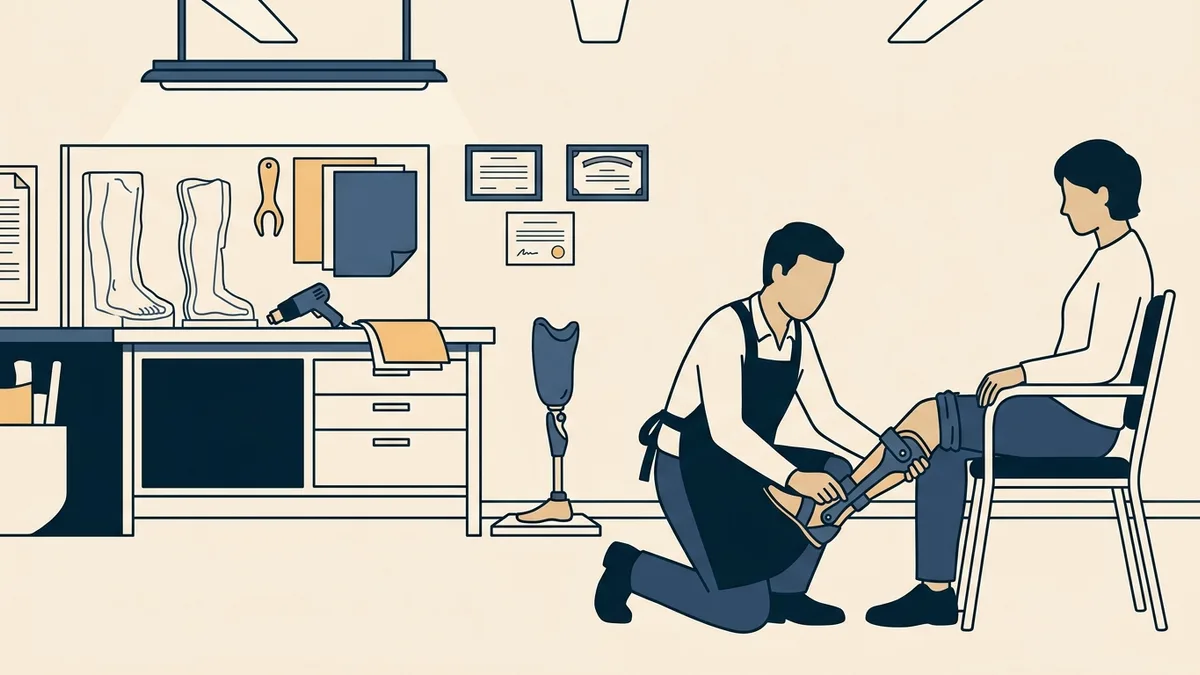
O&P practices usually need practitioner licenses rather than a DME license for custom work: Texas, Florida and Ohio license orthotists and prosthetists, and Texas accredits O&P facilities under a licensed practitioner's on-site direction. Florida, Ohio, Tennessee and Mississippi carve custom O&P out of their HME laws, but off-the-shelf products can still need a DME license.
An orthotics and prosthetics (O&P) practice that bills Medicare is a DMEPOS supplier, but the state licenses it needs often look nothing like a DME supplier's. Many states license the orthotist or prosthetist as a health professional, some license or accredit the facility too, and several HME licensing laws specifically leave custom O&P out. Medicare, for its part, writes exceptions for O&P personnel into the supplier standards, the bond rule and the accreditation requirement. Getting the combination right matters most for practices that also sell off-the-shelf braces or other DME, because those products can pull them back into a DME license.
Which states license the O&P practitioner?
Two examples from statutes we read:
- Texas. "A person may not practice, attempt to practice, or offer to practice orthotics or prosthetics, act as an assistant to a person who practices orthotics or prosthetics, or in any way hold the person out as being able to practice orthotics or prosthetics unless the person holds a license" under Occupations Code chapter 605 (605.251). Orthotics means "measuring, designing, fabricating, assembling, fitting, adjusting, or servicing an orthosis under an order" from an authorized prescriber (605.002(14)).
- Florida. The statute directs the licensing department to issue "a license to practice orthotics, prosthetics, or pedorthics, or a registration for a resident to practice orthotics or prosthetics," with each discipline licensed independently and a combined prosthetist-orthotist license available (Fla. Stat. 468.803(1)). Renewal is biennial, with a fee "not to exceed $500" and a statewide criminal history check (468.806(1)).
Ohio's HME law refers to individuals licensed "under Chapter 4779. of the Revised Code to practice orthotics, prosthetics, or pedorthics" (Ohio Rev. Code 4752.02(B)(8)), so Ohio licenses these practitioners as well.
Does any state license the O&P facility?
Texas accredits facilities. Its licensing department "may issue an accreditation only to an orthotic or prosthetic facility," a person with several facilities may file one application covering them, and "An orthotic or prosthetic facility must be under the on-site direction of an orthotist or prosthetist licensed by the department in the discipline for which accreditation is sought" (Occupations Code 605.260(a)-(c)). A facility is "a location, including a building or office, where the profession and practice of orthotics or prosthetics normally takes place" (605.002). Opening a second Texas location means planning for a licensed practitioner on site there too.
Do O&P practices also need a state DME license?
Often not for custom O&P, sometimes yes for everything else. Several HME laws carve O&P out:
- Florida: home medical equipment "does not include prosthetics or orthotics or any splints, braces, or aids custom fabricated by a licensed health care practitioner" (Fla. Stat. 400.925(6)).
- Ohio: licensed orthotists, prosthetists and pedorthists are exempt from the HME license requirement (4752.02(B)(8)).
- Tennessee: "Upper and lower extremity prosthetics and related orthotics" are not home medical equipment (Tenn. Comp. R. & Regs. 0720-30-.01(21)(b)).
- Mississippi: the term excludes "upper and lower extremity prosthetics" (Miss. Code 73-21-108(1)(a)).
Read each carve-out precisely. Florida's covers custom-fabricated items by a licensed practitioner, not off-the-shelf braces; Tennessee's covers prosthetics "and related orthotics." An O&P practice that also sells walkers, wheelchairs, CPAP or off-the-shelf braces can need the state's DME license for those lines. North Dakota works the other way: its DME retailer license requires that a qualified licensed health care professional "be on staff to oversee and provide custom orthotics and prosthetics," with Board certification standards that may include ABC or BOC credentials (N.D. Cent. Code 43-15.3-11(1)(a)(1)).
What exceptions does Medicare give O&P practices?
Four, each with conditions:
- Practice location size. The 200-square-foot minimum does not apply to "Orthotic and prosthetic personnel providing custom fabricated orthotics or prosthetics in private practice" if they are state-licensed or practice in a state that does not license O&P personnel (42 CFR 424.57(c)(7)(i)(A)(2)). The rest of the site standards, such as public accessibility, staffing during posted hours and a visible sign, still apply.
- Thirty hours a week. The minimum hours rule "is not applicable at a practice location where a ... DMEPOS supplier is working with custom made orthotics and prosthetics" (424.57(c)(30)(ii)(C)).
- The surety bond. "State-licensed orthotic and prosthetic personnel in private practice making custom made orthotics and prosthetics" are excepted if "The business is solely-owned and operated by the orthotic and prosthetic personnel" and "only billing for orthotic, prosthetics, and supplies" (424.57(d)(15)(i)(B)).
- Accreditation. CMS's DMEPOS accreditation fact sheet (MLN905710) lists orthotists and prosthetists among the "Other Persons" exempt from accreditation. The exemption covers the person; a business with other products or owners should confirm how it applies.
None of these exempts anyone from state licensure. Standard 1 still requires every license a state requires, and it allows a supplier to "contract with a licensed individual or other entity to provide the licensed services unless expressly prohibited by State law" (424.57(c)(1)(ii)(B)). That contracting option is how some DME suppliers offer custom O&P without employing a licensed practitioner, where the state permits it.
Do Medicaid programs add O&P conditions?
Some do. New York Medicaid requires orthopedic footwear to be "dispensed by a provider who is certified or employs others who are certified by" the American Board for Certification in Orthotics, Prosthetics and Pedorthics or the Board of Certification/Accreditation (New York DMEPOS Policy Guidelines, effective July 1, 2026). Pennsylvania's Medical Assistance program pays for prostheses and orthoses only for categorically needy recipients or with prior authorization (55 Pa. Code 1123.58). See Medicaid DME enrollment.
What should an O&P practice check before opening or expanding?
- Practitioner licenses in each state where you fit or adjust devices, for every orthotist, prosthetist and assistant.
- Facility licensing or accreditation where the state requires it, with a licensed practitioner directing each site in Texas.
- Whether your non-custom product lines bring you under the state's DME license.
- Which Medicare exceptions you actually qualify for: solely owned, custom only, licensed.
- Medicaid conditions for footwear, prostheses and orthoses in each program you bill.
How do we help O&P practices?
We map your practitioner, facility and DME licensing state by state, prepare the state applications and your Medicare enrollment, and track renewals. Practitioners keep and renew their own professional licenses; we track the dates for you at $299 per license, per year. State DME licenses are $699 per state, $899 for California, Florida, Georgia and Alabama (pricing). See also off-the-shelf brace suppliers and who is exempt from DMEPOS accreditation.
Common questions
- Does an O&P practice need a state DME license?
- Often not for custom orthotics and prosthetics, which Florida, Ohio, Tennessee and Mississippi exclude from their HME laws. Other products the practice sells, such as off-the-shelf braces, walkers or wheelchairs, can bring it under the state's DME license.
- Does Texas license orthotic and prosthetic facilities?
- Texas accredits them. An orthotic or prosthetic facility must be under the on-site direction of an orthotist or prosthetist licensed in the discipline for which accreditation is sought (Occupations Code 605.260).
- Are O&P practices exempt from the Medicare surety bond?
- Only state-licensed O&P personnel in private practice making custom orthotics and prosthetics, when the business is solely owned and operated by them and bills only for orthotics, prosthetics and supplies (42 CFR 424.57(d)(15)(i)(B)).
- Do orthotists need DMEPOS accreditation?
- CMS lists orthotists and prosthetists among the persons exempt from DMEPOS accreditation (MLN905710). That exemption does not cover state licensure or the other supplier standards.
Need Help with Enrollment or Licensing?
We prepare your Medicare enrollment, accreditation survey and state licenses in the order CMS requires, for your official to sign, and track every one to a decision.