
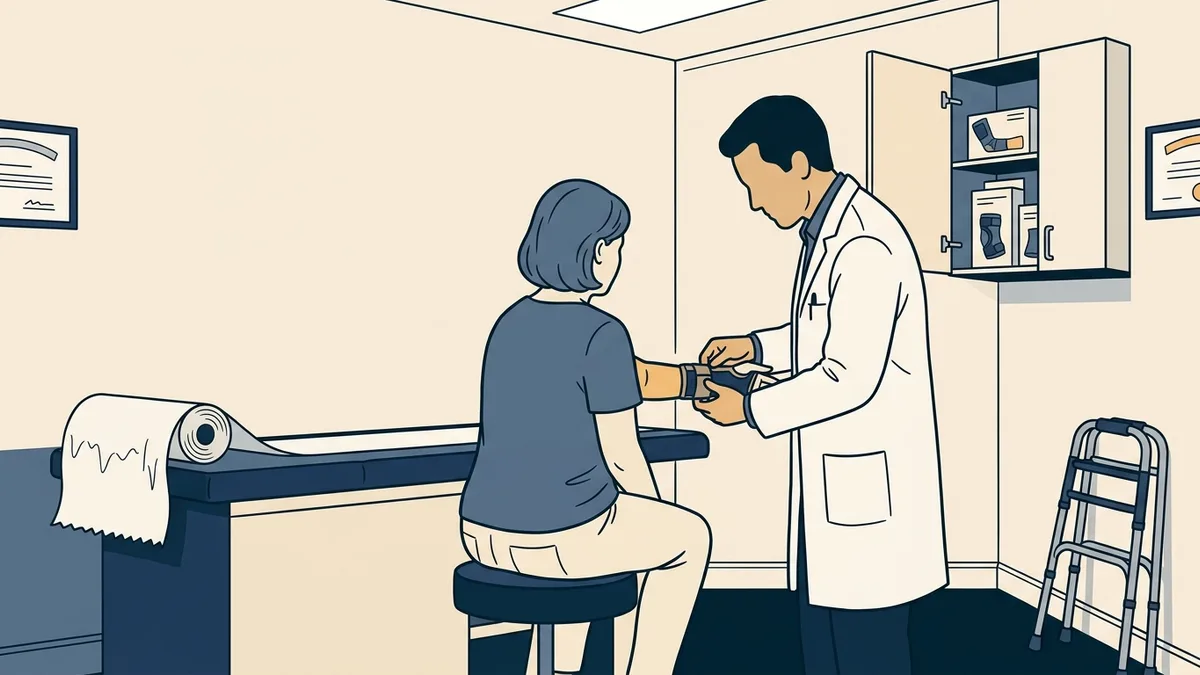
A physician practice that bills Medicare for DME it gives its own patients enrolls as a DMEPOS supplier but is exempt from accreditation, from the surety bond, and from the location-sharing and 30-hour rules for those patients. It may furnish certain items, such as OTS orthotics and insulin pumps, without a competitive bidding contract.
Orthopedic, podiatry, endocrinology and primary care practices often supply DMEPOS at the visit: a knee brace after an injury, a walker for an unsteady patient, a blood glucose monitor for a new diagnosis. When the practice bills Medicare for the item, it is acting as a DMEPOS supplier. The CMS-855S lists "Physician" among its supplier types, and CMS's 2026 moratorium notice refers to "pharmacies, physicians, hospitals, physical therapists, and other DMEPOS supplier types." The rules then carve out several exceptions for practitioners furnishing items to their own patients. Knowing exactly where they apply keeps a practice from either over-preparing or getting caught short.
Does a physician practice need DMEPOS accreditation?
Generally no. CMS's MLN905710 fact sheet lists the eligible professionals exempt from accreditation under section 154(b) of MIPPA: physicians, physician assistants, nurse practitioners, clinical nurse specialists, certified nurse-midwives, certified registered nurse anesthetists, clinical psychologists, clinical social workers, physical therapists, occupational therapists, qualified audiologists, qualified speech-language pathologists, registered dietitians and nutritional professionals. Opticians, orthotists and prosthetists are also exempt as "other persons." CMS says it does not currently use its authority to exempt anyone else based on their licensing.
Exempt from accreditation is not exempt from everything else. The practice still enrolls as a DMEPOS supplier, meets the supplier standards that apply, and holds any state license a state requires for the items. See who is exempt from accreditation.
Is the practice exempt from the surety bond?
When it supplies only its own patients, yes. 42 CFR 424.57(d)(15)(i)(C) gives physicians and nonphysician practitioners an exception to the bond "when items are furnished only to the physician or nonphysician practitioner's own patients as part of his or her physician service." Physical and occupational therapists in private practice get a similar exception if the business is solely owned and operated by the therapist, items go only to the therapist's own patients, and it bills only for orthotics, prosthetics and supplies (424.57(d)(15)(i)(D)). Lose the qualifying conditions, for example by starting to sell to the public, and you must submit a bond within 60 days (424.57(d)(15)(ii)).
Which supplier standards relax for a practice?
- Sharing space. The ban on sharing a practice location with another Medicare supplier or provider does not apply where a physician or nonphysician practitioner furnishes items to his or her own patient as part of a professional service, or where a physical or occupational therapist does the same (424.57(c)(29)(ii)).
- Hours. The 30-hours-a-week open-to-the-public rule does not apply at a location where a physician, or a physical or occupational therapist, furnishes items to their own patients as part of a professional service (424.57(c)(30)(ii)).
The other standards still apply: honest application information and 30-day change reporting, delivery and instructions, complaint handling, warranty, returns and record-keeping, insurance, and the rest of the 30 in 424.57(c). See the 30 supplier standards.
Do practices need a Round 2028 competitive bidding contract?
For some items, no. CBIC's FAQ explains that physicians, treating practitioners and hospitals may furnish certain competitively bid items without a contract if all of these apply: the items are limited to "crutches, canes, walkers, folding manual wheelchairs, blood glucose monitors, infusion pumps that are DME, and off-the-shelf (OTS) orthotics"; they go to the practitioner's own patients as part of a professional service; and they are billed under the hospital's, physician's, treating practitioner's or group practice's billing number. For Round 2028 specifically, CBIC's exceptions fact sheet names insulin infusion pumps and OTS orthotics. A physical or occupational therapist in private practice may furnish OTS orthotics to the therapist's own patients without a contract (42 CFR 414.404(b)). Payment is the single payment amount for the patient's area.
Two limits matter. The exceptions "do not apply" to CGMs, CGM supplies, ostomy, tracheostomy or urological supplies, per CBIC. And a DME company that a physician owns is not exempt: CBIC says program requirements "apply irrespective of who owns a DME company." See off-the-shelf brace suppliers.
When does a practice stop qualifying?
Each exception is built around the same idea: the item goes to the practitioner's own patient, as part of the professional service. A practice crosses the line when it:
- Sells or rents to people who are not its patients, or to patients of other practitioners.
- Sets up a separate DME company, even under common ownership. That company is a full DMEPOS supplier and needs accreditation, a bond, its own location meeting every standard, and a competitive bidding contract for bid items.
- Ships supplies on a recurring basis outside the professional service, such as monthly mail-order supplies.
Which state rules apply to a practice?
State DME licensing laws often exempt practitioners, but the exemptions are written differently. Florida exempts licensed practitioners who use HME in their practice "but do not sell or rent home medical equipment to their patients," and separately exempts physicians for the sale or rental of electrostimulation equipment to their patients (Fla. Stat. 400.93(5)). A Florida practice that sells braces or walkers to its patients falls outside both. California exempts prescribers from its home medical device retailer license. Read your own state's exemption carefully; our state index lists what we have verified.
How do we help practices that supply DME?
For a practice furnishing items to its own patients, the work is usually the CMS-855S, the right exemption selections, insurance documentation and any state license, rather than accreditation and a bond. The Medicare DMEPOS Enrollment Package is $1,295 for the first location; state licenses are $699 each ($899 in California, Florida, Georgia and Alabama); a $149 Readiness Review tells you which exceptions you qualify for before you file. Your authorized official signs the application. If the practice is building a separate DME company, see starting a DME company. No one can promise enrollment.
Common questions
- Does a physician office need to be accredited to supply DME?
- No. Physicians are among the eligible professionals exempt from DMEPOS accreditation under MIPPA, per CMS's MLN905710. The practice still enrolls as a DMEPOS supplier and meets the applicable supplier standards and state licensing.
- Does a physician practice need a DMEPOS surety bond?
- Not when it furnishes items only to its own patients as part of the physician service, under 42 CFR 424.57(d)(15)(i)(C). If that stops being true, a bond is due within 60 days.
- Can a physician supply CGMs without a Round 2028 contract?
- No. CBIC says the physician and hospital exceptions do not apply to CGMs, CGM supplies, ostomy, tracheostomy or urological supplies. They cover items such as insulin pumps and OTS orthotics for the practice's own patients.
- Is a DME company owned by a physician exempt from competitive bidding?
- No. CBIC says program requirements apply irrespective of who owns a DME company. The exceptions apply only to practitioners furnishing items to their own patients as part of a professional service.
Need Help with Enrollment or Licensing?
We prepare your Medicare enrollment, accreditation survey and state licenses in the order CMS requires, for your official to sign, and track every one to a decision.