
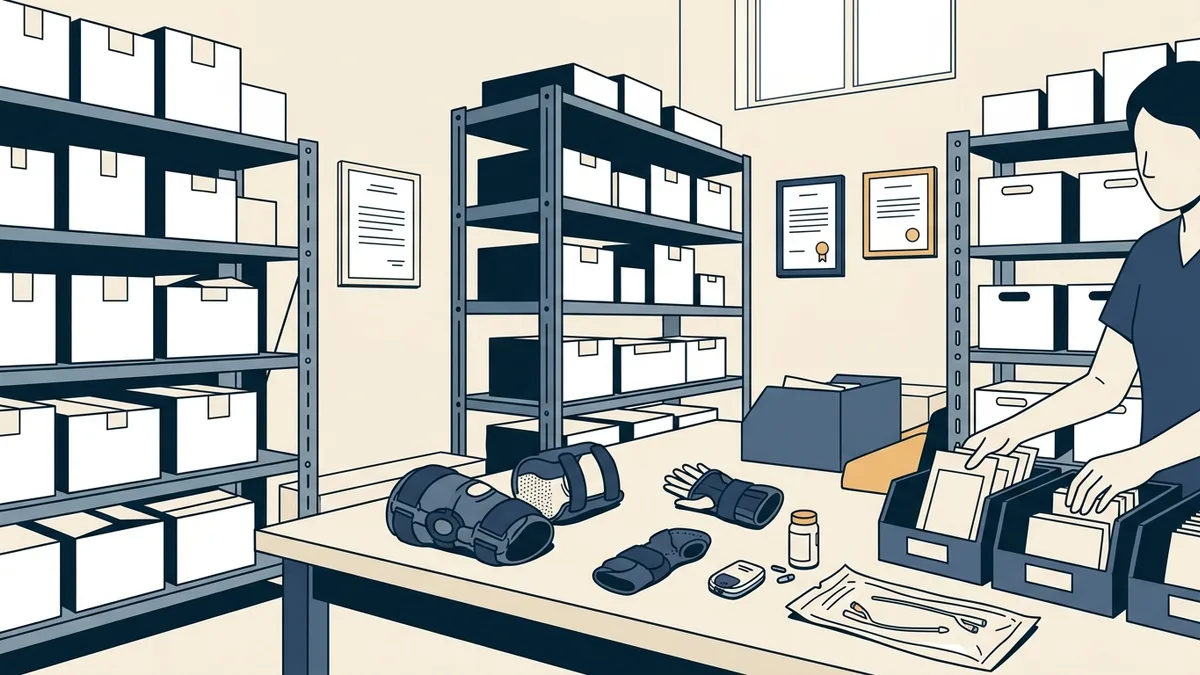
Round 2028 bids seven categories nationwide: Class II CGMs and insulin pumps, hydrophilic urinary catheters, ostomy supplies, urological supplies, and off-the-shelf back, knee and upper extremity braces. Each has a lead item and bid limit, and CMS plans between three and ten contracts per category, more if needed for small suppliers or demand.
Round 2028 of the DMEPOS Competitive Bidding Program covers seven product categories, all bid in one nationwide remote item delivery area during the same bid window. The Competitive Bidding Implementation Contractor (CBIC) publishes the list with each category's lead item and bid limit, and in August 2026 CMS added how many contracts it expects to award in each.
What are the seven categories, their lead items and bid limits?
From CBIC's Product Categories page and its Determining the Number of Contract Awards fact sheet:
- Class II continuous glucose monitors and insulin pumps. Lead item A4239, bid limit $273.28. Contracts planned: 10.
- Hydrophilic urinary catheters. Lead item A4296, bid limit $8.86. Contracts planned: 10.
- Ostomy supplies. Lead item A4385, bid limit $7.28. Contracts planned: 6.
- Off-the-shelf (OTS) back braces. Lead item L0651, bid limit $855.26. Contracts planned: 3.
- OTS knee braces. Lead item L1852, bid limit $691.80. Contracts planned: 4.
- OTS upper extremity braces. Lead item L3916, bid limit $591.58. Contracts planned: 5.
- Urological supplies. Lead item A4352, bid limit $8.86. Contracts planned: 5.
CMS may award more contracts than these to reach its target that at least 30 percent of contract suppliers be small suppliers, or to meet beneficiary demand (42 CFR 414.414(g) and (i)). The full list of lead and non-lead HCPCS codes in each category is in a spreadsheet on the CBIC site.
How does the lead item bid work?
A bidder submits a single amount per category, for the lead item. CBIC's Lead Item Bidding and Pricing fact sheet calls it a composite bid, because a contract supplier must furnish every item in the category and CMS prices the non-lead items from it. The single payment amount for the lead item is the 75th percentile of bids from suppliers in the winning range (42 CFR 414.416(b)(1)). Each non-lead item's amount is the lead item amount multiplied by a ratio based on 2015 fee schedule averages. So a low lead item bid lowers payment for everything else in the category, which is why CBIC tells bidders to account for the cost of every item when they bid.
Bid limits differ by category. For the back and knee brace lead items (L0651 and L1852), the bid must be at or below the average of the 2026 adjusted fee schedule amounts for nonrural areas (42 CFR 414.412(b)(11)); for the others, at or below the average of the 2026 unadjusted fee schedule amounts across all states and territories (414.412(b)(12)).
Which category details trip suppliers up?
CGMs and insulin pumps
Payment for these items changes on January 1, 2028. CMS's fact sheet on CGMs and insulin pumps says Medicare moves to bundled monthly rental. For CGM and pump equipment the beneficiary already owns on December 31, 2027, only contract suppliers may furnish the supplies, which are paid separately until the equipment reaches its useful lifetime or is replaced. Code A4227 (supplies for a patient-owned insulin pump, per month) replaces A4224 and A4225 for Medicare on that date. Class III CGMs, and pumps used with them, are excluded from competitive bidding but see their supply payment capped at the Class II amount. Non-contract suppliers renting a Class II CGM or insulin pump at the start may elect to be grandfathered for those rentals. More in enrollment and licensing for CGM and insulin pump suppliers.
Hydrophilic catheters and urological supplies
These are now two separate categories; CBIC's FAQ says hydrophilic urinary catheters are "a distinct product category, separate from other urological supplies." Three new hydrophilic intermittent catheter codes (A4295, A4296 and A4297) took effect January 1, 2026, and a revised urological supplies local coverage determination also took effect that date, which CBIC's FAQs address for utilization data. A supplier of both needs to bid, and be accredited for, both categories.
Ostomy supplies
Tracheostomy supplies are not in Round 2028, either on their own or inside the ostomy category; CBIC says any enrolled supplier may keep furnishing them until they are phased in. Suppliers of ostomy supplies without a contract may not keep furnishing them to existing Medicare patients once contracts start.
Off-the-shelf braces
Off-the-shelf orthotics are defined in 42 CFR 414.402 as orthotics that "require minimal self-adjustment for appropriate use and do not require expertise in trimming, bending, molding, assembling or customizing to fit." On October 7, 2026, CMS said it is reviewing a small percentage of products on the PDAC Product Classification List that may have been wrongly classified as OTS braces, may remove some products from certain codes, but does not expect to remove any HCPCS codes from the three brace categories. See off-the-shelf brace suppliers and competitive bidding.
What is not in Round 2028?
- Items covered under Medicare Part D. The program includes only Part B items (CBIC FAQ).
- Tracheostomy supplies, as above.
- Class III CGMs and insulin pumps used with Class III CGMs.
- Every other DMEPOS category, such as oxygen, hospital beds and wheelchairs.
Do physician and hospital exceptions apply to these categories?
Only to some items. Under 42 CFR 414.404, physicians, treating practitioners and hospitals may furnish competitively bid insulin infusion pumps and off-the-shelf orthotics to their own patients without a contract, and physical or occupational therapists in private practice may furnish OTS orthotics to their own patients. CBIC says the exceptions do not apply to CGMs, CGM supplies, ostomy, tracheostomy or urological supplies. A DME company owned by a physician is not exempt; CBIC says program requirements "apply irrespective of who owns a DME company." Details in when a physician practice supplies DME.
Which requirements apply to every category before you bid?
The same three things, applied to every item in the category:
- Accreditation for the lead item and all non-lead items, with no exemptions (CBIC, Bidder Eligibility Requirements). If your accreditation does not list a product, add it with your accrediting organization now; a new product category needs to be reported so the organization can survey it if needed.
- State licenses for every state and territory that requires one for those items, current in PECOS by the close of the bid window. See the licensing deadline.
- Enrollment that lists the products and states in PECOS.
How can we help you get ready for the categories you will bid?
We check your accreditation scope and PECOS product list against the HCPCS codes in each category you plan to bid, then build the state license map for those products. A DMEPOS Readiness Review is $149, credited toward a package. State licenses are $699 each ($899 in California, Florida, Georgia and Alabama), or $4,995 for 10 states and $9,995 nationwide; a change of information to update products or licenses in PECOS is $249. You pay every state and accreditation fee directly. We do not price bids, and no one can promise a contract.
Common questions
- How many contracts will CMS award in each Round 2028 category?
- CMS's August 2026 fact sheet lists 10 for CGMs and insulin pumps, 10 for hydrophilic catheters, 6 for ostomy supplies, 5 for urological supplies, 5 for upper extremity braces, 4 for knee braces and 3 for back braces. CMS may add contracts for small suppliers or demand.
- Are hydrophilic catheters part of the urological supplies category?
- No. CBIC confirms hydrophilic urinary catheters are a distinct product category, separate from urological supplies, with its own lead item (A4296) and bid limit.
- Are tracheostomy supplies included in Round 2028?
- No. CBIC says CMS will not phase in tracheostomy supplies in Round 2028, and any enrolled supplier may keep furnishing them until they are phased in.
- What does a lead item bid cover?
- It is a composite bid for every item in the category. CMS sets the lead item's single payment amount at the 75th percentile of winning bids and prices non-lead items by ratio from it, so the bid should cover the cost of all items.
Need Help with Enrollment or Licensing?
We prepare your Medicare enrollment, accreditation survey and state licenses in the order CMS requires, for your official to sign, and track every one to a decision.