
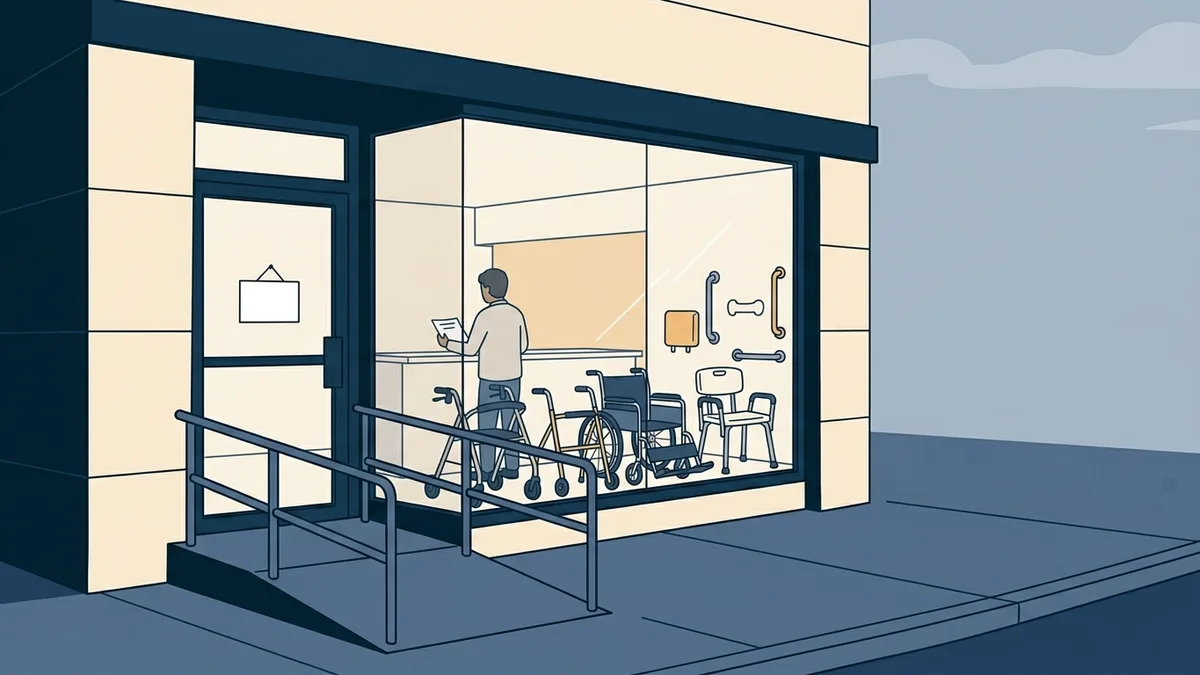
New York Medicaid requires site-specific Medicare approval before a DME supplier applies, licensure where the supplier is located if that state has one, and, for suppliers in or near New York, a staffed walk-in store open to the public. Out-of-state mail-order suppliers are considered only case by case. Applications go through the Provider Services Portal.
New York's Medicaid program sets its DME enrollment rules in the eMedNY DMEPOS Policy Manual, whose current version took effect July 1, 2026. It is stricter than most states in two ways: it requires Medicare approval for the exact site before you apply, and it expects suppliers in and around New York to run a staffed storefront that the public can walk into. New York does not appear to have a general state DME license of its own, which makes Medicaid enrollment the main state-level gate. See New York DME requirements and DME licensing in New York.
What has to be true before you apply?
The manual's "Requirements for Participation" are short and absolute. Medical and surgical supplies, DME, orthopedic footwear, and prosthetic and orthotic appliances "must be dispensed by a DMEPOS provider with site-specific Medicare approval prior to submitting their application for enrollment." The provider "must be licensed/registered by the appropriate authority, if existing, in the state in which the provider is located." And an application to provide an item whose HCPCS code is not active in New York fee-for-service Medicaid will be denied.
So: Medicare PTAN for that location, any license your home state requires, and a product list that matches codes New York actually covers.
What does New York expect of an in-state supplier?
For suppliers located in New York, or in the common medical marketing area of the contiguous states, the manual requires the business to:
- Be a fully operational, independent walk-in business open to the general public and staffed with trained personnel who can fit, demonstrate and service what it sells.
- Handle returns and adjustments, and replacements or repairs for defects.
- Be open and doing business before it enrolls in Medicaid.
- Have a storefront with a sign showing it is open to the public and its hours, and operate during normal business hours.
- Clearly display the items it provides.
- Have appropriate door width, a ramped entrance, accessible parking or other features allowing access for people with physical disabilities.
These overlap with Medicare's supplier standards (a public, staffed site with posted hours and a sign under 42 CFR 424.57(c)(7)) but go further: New York wants a store, not just an office that meets the 200 square foot minimum.
Can an out-of-state mail-order supplier enroll?
Only case by case. The manual says New York will consider out-of-state providers that are "solely mail order DMEPOS providers" if either:
- The supplier dispenses standard DME or supplies that cannot be obtained from enrolled New York suppliers, and does not dispense custom or customized equipment or items needing fitting, adjustment or training; or
- It is a manufacturer that bills and dispenses directly to members, provides direct customer service, 24-hour clinical support for equipment problems and backup equipment, attests to understanding New York Medicaid rules, and follows the state's delivery guidelines.
A national supplier of common supplies should not assume New York fee-for-service Medicaid is open to it.
Which product lines carry extra conditions?
- Orthopedic footwear (specialty 711). Must be dispensed by a provider certified, or employing someone certified, by the American Board for Certification in Orthotics, Prosthetics and Pedorthics or the Board of Certification/Accreditation. New York also checks whether the county where the storefront sits already has enough enrolled footwear providers, and denies the application if it does (18 NYCRR 504.5(a)(14)).
- Complex rehab equipment. Providers of individually configured DME such as complex wheelchairs must employ at least one full-time RESNA-certified Assistive Technology Professional, provide service and repair by qualified technicians, give written information on service and after-hours repairs, and supply loaner equipment during repairs.
- Oxygen. eMedNY lists category of service no. 0323 for oxygen-related equipment alongside category of service no. 0321 for DME appliances or supplies and footwear.
How do multiple locations and moves work?
Each operating location needs its own NPI and its own Medicaid enrollment, and "an additional operating location cannot be added to an existing provider service address unless it is a result of an address change." A supplier that relocates must make sure the new address is a fully operational walk-in store meeting every enrollment criterion; one that moves somewhere that does not meet them "will be considered non-compliant and will be terminated." Plan a move with Medicaid in mind, and report it to Medicare within 30 days too.
Where is the application filed?
Through the New York State Medicaid Provider Services Portal (PSP). eMedNY's DME enrollment page says to use the PSP for initial enrollment, enrolling another NPI, revalidation, reinstatement or reactivation, and reporting an ownership change, and that an application fee is required. New York says it is revalidating all providers by June 2028, with revalidation through the PSP and communications coming from its enrollment vendor by email. Watch for that letter.
How does Medicare interact with New York Medicaid billing?
For patients who have both Medicare and Medicaid, the manual says the provider must get Medicare's approval or denial before asking Medicaid for prior approval, with listed exceptions such as items Medicare does not cover by statute. When a supplier only pursues the Medicare coinsurance and deductible, the claim crosses over automatically. For billing detail, see White Glove Medical Billing on billing dual-eligible patients.
Why do New York DME applications get denied?
- No site-specific Medicare approval yet.
- A location that is an office or warehouse, not a walk-in store open to the public.
- Products whose HCPCS codes are not active in New York fee-for-service Medicaid.
- An out-of-state mail-order supplier that does not meet either case-by-case path.
- Orthopedic footwear in a county New York considers adequately served.
- An ownership list that does not match Medicare's.
How do we help with New York?
Our Medicaid DME Enrollment service is $499 for New York. We check your location against the manual's storefront criteria before you file, confirm your product list against active codes, prepare the PSP application from your Medicare file, and track it. Your authorized representative signs and submits in the portal account, which stays yours. If the Medicare side is not done, the Medicare DMEPOS Enrollment Package ($1,295) comes first. No one can promise New York will enroll you. Managed care plan contracting in New York is handled through our sister company, White Glove Credentialing. See Medicaid DME enrollment for the federal rules every state follows.
Common questions
- Do I need Medicare approval before applying to New York Medicaid for DME?
- Yes. New York's DMEPOS Policy Manual, effective July 1, 2026, requires site-specific Medicare approval before you submit the Medicaid enrollment application.
- Can a mail-order DME company enroll in New York Medicaid?
- Only case by case. An out-of-state, solely mail-order supplier must dispense standard items not available from enrolled New York suppliers, or be a manufacturer meeting service and support conditions listed in the manual.
- Does New York Medicaid require a storefront?
- For suppliers in New York or the nearby contiguous-state market, yes. The manual requires a fully operational, staffed walk-in business open to the public, with a sign, posted hours and accessible entry.
- Does each location need its own New York Medicaid enrollment?
- Yes. Each operating location needs its own NPI and enrollment, and a new location cannot be added to an existing service address except through an address change.
Need Help with Enrollment or Licensing?
We prepare your Medicare enrollment, accreditation survey and state licenses in the order CMS requires, for your official to sign, and track every one to a decision.