
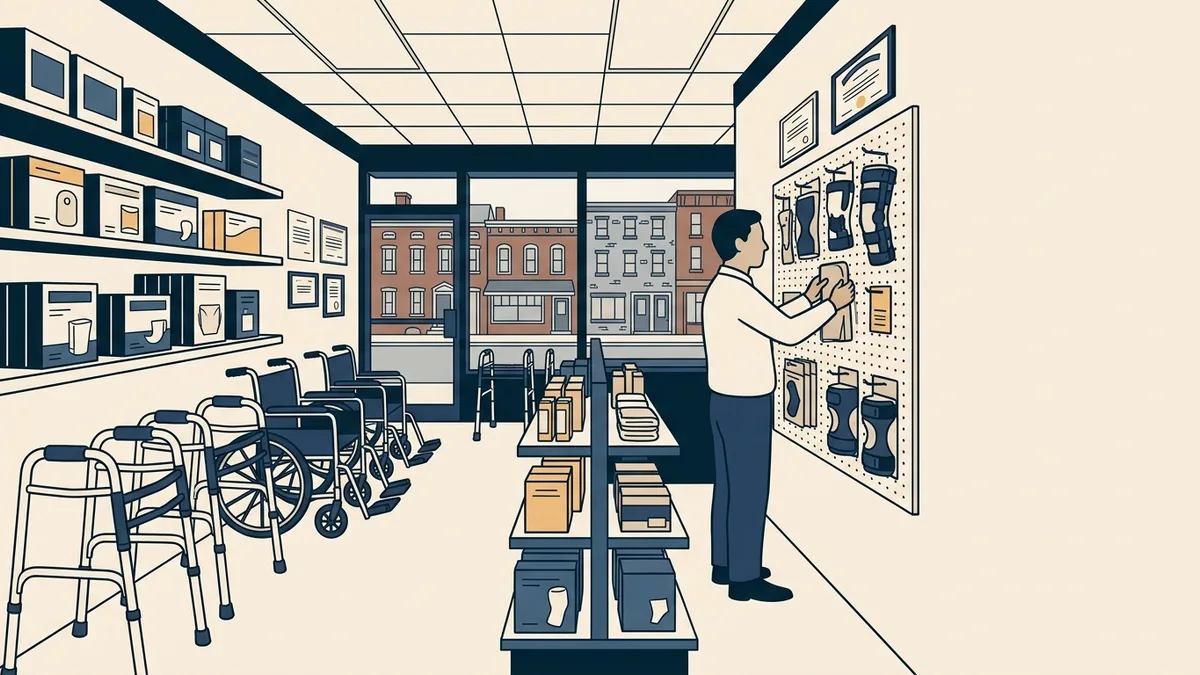
Pennsylvania has no dedicated HME license, but 28 Pa. Code 25.113 requires anyone who retails drugs or devices in the Commonwealth to register with the Department of Health every year, per place of business. The device-only fee is $25. Braces, crutches, walkers, wheelchairs, ostomy supplies and oxygen equipment are devices. Confirm the current process with the Department.
Pennsylvania does not have a home medical equipment license like Florida's or Ohio's, and that has led to a common assumption that Pennsylvania requires nothing of DME suppliers. That is wrong. Pennsylvania's Department of Health rules under the Controlled Substance, Drug, Device and Cosmetic Act require a yearly registration from "Every person who manufactures, distributes or retails drugs or devices within the Commonwealth," with a separate registration "for each place where drugs or devices are manufactured or sold" (28 Pa. Code 25.113(a), (d)). For a business that sells devices only, the annual fee is $25 (28 Pa. Code 25.115(d)).
The rule is old and modest, and we have not confirmed on a current Department of Health page how the registration is administered today. Before you file, confirm the current application and process with the Pennsylvania Department of Health. The obligation itself is in the Pennsylvania Code as of the August 8, 2026 update.
Does a DME supplier sell "devices" under Pennsylvania's rule?
Almost certainly. The rule's definition of device covers instruments and apparatus for treating disease or affecting the body, and then lists items that include (28 Pa. Code 25.1):
- "elastic bandages and braces";
- "Body braces and supports, including, but not limited to, crutches, walkers and orthopedic braces and supports";
- "Colostomy and ileostomy appliances, bags and supplies";
- blood pressure testing apparatus, dialysis machines and "Electronic therapeutic or diagnostic products";
- "Inhalation therapy equipment and emergency breathing equipment, including but not limited to atomizers, intermittent positive pressure breathing units, iron lungs, vaporizers, and oxygen equipment";
- needles and syringes;
- "Physical therapy equipment for professional or home use," including electronic muscle stimulators and traction units;
- artificial limbs, hearing aids and wheelchairs.
A medical supply company, an O&P practice selling braces, or a mail-order supplier of ostomy and urological supplies is selling devices in this sense.
Who has to register, and who is exempt?
"Only persons actually engaged in such activities are required to obtain a registration; related or affiliated persons not engaged in such activities are not required to be registered," so a parent company or stockholder that does not itself sell need not register (25.113(b)). Section 25.114 exempts, among others:
- federal, state and local officials acting in their official duties;
- "Practitioners licensed by law to prescribe, administer or dispense drugs or devices when operating under the authority of the licensure," though "Registration is required if practitioners engage in the manufacture or distribution of drugs or devices";
- employees and agents of a registered business acting in its regular course;
- common or contract carriers and warehouses holding goods in the usual course of business.
The rule adds that an exemption "does not relieve persons from compliance with other requirements or duties prescribed by law" (25.114(7)).
Registration as a distributor is required for anyone not exempt who distributes controlled substances, nonproprietary drugs, "Devices which are labeled to require a physician's order," or large quantities of certain drugs (25.113(e)). A supplier that sells prescription devices onward to other businesses should read that subsection closely; one selling to patients registers as a retailer.
How much is the registration?
Under 28 Pa. Code 25.115:
| Category | Annual fee | Late fee |
|---|---|---|
| Devices (manufacturing, distributing or retailing), if not registered for drugs | $25 | $10 |
| Retailer of other drugs | $10 | $2 |
| Distributor of other drugs | $25 | $5 |
| Distributor of controlled substances and nonproprietary drugs | $100 | $10 |
"Only the single highest fee will apply at a given location" (25.115(f)), and 501(c)(3) organizations do not pay (25.115(g)). Late fees accrue monthly, "multiplying the appropriate fee by the number of months ... by which the registrant is late," starting from the month the business is notified it is not registered. If the Department has to sue to compel registration, a $250 compulsory registration fee is added (25.115(a), (e)).
What about suppliers outside Pennsylvania?
The rule speaks to activity "within the Commonwealth." For manufacturers and distributors without an establishment in Pennsylvania, it gives a choice: "either obtain a registration or maintain with the secretary an up-to-date listing of the names and addresses of its representatives operating within the Commonwealth" (25.113(c)). It does not say how an out-of-state retailer shipping to Pennsylvania patients is treated. That is a question to put to the Department of Health in writing. See licensing as an out-of-state DME supplier.
What does Pennsylvania Medicaid require?
Pennsylvania's Medical Assistance program sets its own prerequisites for medical supply providers (55 Pa. Code 1123.41, pointing to 1101.41 to 1101.43 and 1101.51):
- In-state providers "shall be currently licensed and registered or certified or both by the appropriate State agency," complete the enrollment form and sign the provider agreement (1101.42(a)).
- Out-of-state providers "shall be licensed, and registered or certified or both, by the appropriate agencies in their respective states," and must be participating in their own state's Medicaid program if it has one; providers in adjacent states that regularly serve Pennsylvania recipients sign a written provider agreement (1101.42(b)).
- Owners with 5 percent or more must be disclosed, and changes of 5 percent or more reported within 30 days (1101.43(b)(1)).
The Medical Assistance rules also set item-level conditions, for example a cardiopulmonary diagnosis on the prescription and physician recertification at least every 6 months for oxygen (55 Pa. Code 1123.55), and prior authorization for prostheses and orthoses outside the categorically needy (1123.58). Our Medicaid DME enrollment post covers the general pattern, and our sister company White Glove Credentialing explains why Medicaid enrollment differs by state.
Which Pennsylvania credential goes into PECOS?
The CMS-855S asks each location to list the states it serves and to "submit all required licenses for the products and services being provided" (Section 2D). The Department of Health registration is the Pennsylvania credential to attach for a location that sells devices there. For Round 2028 competitive bidding, every license a state requires must be current in PECOS by the close of the bid window (CBIC, Licensure for Bidders). See getting your state licenses into PECOS.
How do we help with Pennsylvania?
Pennsylvania is a standard state at $699 (pricing), and much of the work is confirming the current process with the Department of Health, then preparing the registration for each place of business and the Medical Assistance enrollment ($499) if you want it. Your owner or an officer signs, and you pay the Department. See the Pennsylvania state page.
Common questions
- Does Pennsylvania require a DME license?
- Not a dedicated HME license, but the Department of Health's rules require an annual registration from anyone who manufactures, distributes or retails drugs or devices in Pennsylvania, with a separate registration for each place of business (28 Pa. Code 25.113).
- How much is Pennsylvania's device registration?
- $25 a year for a business registered only for devices, with a $10 late fee accruing monthly once the business is notified. Only the single highest applicable fee applies at a location (28 Pa. Code 25.115).
- Are braces and ostomy supplies devices in Pennsylvania?
- Yes. The rule's device definition lists braces and supports, crutches and walkers, colostomy and ileostomy appliances and supplies, inhalation therapy and oxygen equipment, and wheelchairs (28 Pa. Code 25.1).
- What does Pennsylvania Medicaid require from DME suppliers?
- In-state providers must be licensed and registered or certified by the appropriate state agency; out-of-state providers by their own state's agencies, and participating in their own state's Medicaid program if it has one (55 Pa. Code 1101.42).
Need Help with Enrollment or Licensing?
We prepare your Medicare enrollment, accreditation survey and state licenses in the order CMS requires, for your official to sign, and track every one to a decision.